
Head Start Deliberation
Take Action: Lets Make Head Start’s Promise Real for All Children
PEOPLE’S COMMISSION TO MAKE OUR CHILDREN HEALTHY
A federal rule, a public program, and a child’s future are connected.
This Action Center helps citizens follow those connections: from one child’s First 1,000 Days, to the public systems that shape opportunity, to the larger question of what America should build for the next generation.
Choose where you would like to begin.
Three ways into the work
Begin with a child. Understand the system. Help build what comes next.
1. Moonshot Journeys
Begin with one child, one family, and one community.
Follow a privacy-protected Moonshot Class journey to see how early learning, health, nutrition, family support, local resources, and public decisions shape a child’s opportunity to flourish.
[Watch: A Child at the Center]
[Explore Moonshot Journeys ↓]
2. Democracy Stack and Citizen Toolbox
Understand the system. Find your place in it.
See how Congress, federal agencies, local programs, families, communities, and citizens share responsibility for Head Start. Then use practical tools to follow the rule, ask questions, map stakeholders, and participate meaningfully.
[Watch: How the System Works]
[Explore the Citizen Toolbox ↓]
3. The Public Start-Up and Resource Center
Move from protecting a program to building opportunity.
Examine what Head Start has taught the country about children and families—and explore the evidence, public debate, resources, and unanswered questions about making the conditions for flourishing more available to every child.
[Watch: What America Can Build]
1. Moonshot Journeys
Every public decision eventually reaches a child, a family, and a community. Moonshot Journeys help us see that connection clearly.
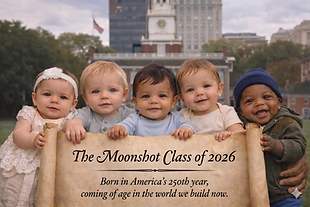
When we talk about Head Start, regulations, or federal funding, it can be easy to lose sight of the people at the center of those decisions.
A Moonshot Journey begins with one child’s first 1,000 days—not to turn a child into a political symbol, but to make public responsibility visible.
Each journey helps us follow the conditions around a child: family support, health care, nutrition, early learning, housing, transportation, and the local and national decisions that affect each of them.
The question is simple: what would it take for this child—and every child—to have a genuine opportunity to flourish?
Choose a Moonshot Journey and begin there.
Each stakeholder can then choose a Moonshot Journey, submit experience, ask a question, or contribute evidence.
Learn More
Change the text and make it your own. Click here to begin editing.
2. Democracy Stack and Citizen Toolbox
Good intentions are not enough. Citizens need to understand how the system works, who has responsibility, and where their voices can matter.
Head Start is part of a larger democratic system.
Congress appropriates funding. Federal agencies write and enforce rules. States, local programs, governing boards, families, health professionals, and communities each have a role. Citizens do too.
The Democracy Stack helps make that system understandable. It shows where decisions are made, how authority is shared, what information citizens need, and where public participation can have real force.
The Citizen Toolbox turns that understanding into action: a rule navigator, a stakeholder map, a public-question bank, accountability cards, and tools for preparing comments or testimony.
Democracy works best when citizens are not spectators of systems they cannot see. These tools are designed to help people understand, question, and participate.
Find the materials that support an informed public conversation.
Citizen Briefs
Plain-language guides to Head Start, the proposed changes, and the rulemaking process.
Deliberation agenda
The current questions, schedule, stakeholders, and planned public work.
Evidence and research
Research on early childhood, family well-being, program quality, and outcomes.
Head Start Rule Navigator
A plain-language guide to the proposed changes: what the rule says, what may change, and which questions remain open
Stakeholder Map
An interactive view of the families, programs, agencies, communities, and public institutions involved in Head Start.
Public Question Bank
A growing collection of questions submitted by citizens and answered, where possible, with evidence, context, and competing perspectives.
3. The Public Start-Up and Resource Center
The immediate question is how to respond to the proposed changes. The larger question is what America should build for the next generation.
Head Start began with a recognition that children need more than a classroom to flourish.
They need healthy beginnings, stable families, good nutrition, developmental support, caring relationships, and communities able to stand with parents during the years that matter most.
For sixty years, Head Start has helped show what a more comprehensive public commitment to children can look like. The Public Start-Up asks what we can learn from that experience.
How do we protect what works? Where does the evidence show important gaps? What are the costs, tradeoffs, and responsibilities involved in extending real opportunity to more children and families?
This is not a call for a predetermined answer. It is an invitation to a serious public inquiry: how can America build the conditions for every child to flourish?
The Resource Center is where you can follow the evidence, the debate, the public record, and the work ahead.
A good public conversation needs more than documents. It needs clear explanations and the voices of people who understand what is at stake.
Media and video
Short explainers, interviews, recorded discussions, and public presentations.
Official documents
Proposed rules, notices, agency materials, and public-record sources.
Moonshot Digital Programs
Moonshot Press is building practical digital tools that help citizens move from information to participation.
Comments
Follow the Public Comments to the Proposed regulation
Articles and analysis
Moonshot Press reporting and selected outside commentary.
Agenda
Get updates on our work